
Insulating When Bathroom Remodeling
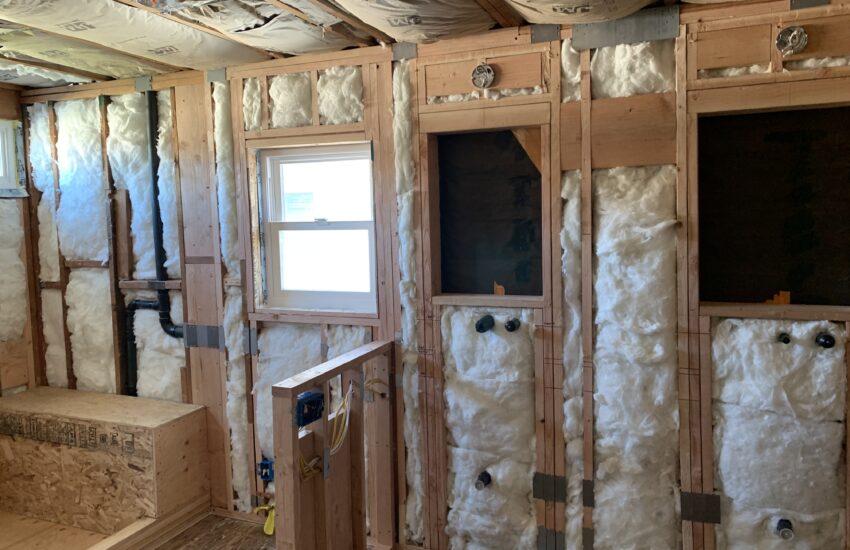
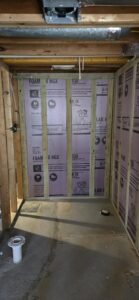
Insulating when bathroom remodeling is essential and highly recommended for comfort, energy savings, soundproofing, and mold prevention. Building code requires that all conditioned spaces be insulated. Conditioned spaces include outside walls, attics, and raised foundation (crawl space) flooring. Unconditioned spaces include inside (interior) walls.
Generally, attics require R30 to R49, floors R19, and walls R13 to R21 insulation. R-value measures thermal resistance (higher is better).
Does Insulating When Bathroom Remodeling Require All Walls be Insulated?
Only conditioned spaces must be insulated. Unconditioned spaces are optional. Why? There is minimal to no heat or cold transfer between the two sides of an interior wall. When insulating conditioned spaces, the R-value must comply with California’s Title 24 energy codes. It’s not something you can decide on your own. Moreover, the construction of the wall, floor, and ceiling assemblies or cavities will determine the type and size of insulation that can be used.
Insulating When Bathroom Remodeling Provides Important Benefits
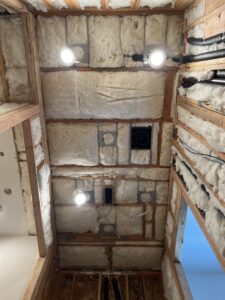 Insulating interior bathroom walls when remodeling is always the right decision. This helps maintain a constant temperature in the bathroom by increasing thermal efficiency.
The inside of the bathroom will stay warmer in the winter, and cooler in the summer. The tile on the shower walls will be warmer in the winter, reducing the transfer of outside cold into the bathroom. For a warmer bathroom, consider a bathroom floor heating system for just pennies a day.
Another great benefit is soundproofing. Insulation will greatly reduce or eliminate shower and toilet use noises. The entire bathroom space will be quieter, providing more privacy and a more comfortable environment.
It will also help to prevent mold and mildews within the wall, ceiling, and floor cavities.
What Insulation Should Be Used When Insulating the Bathroom?
There are many different types of insulation. The ones presented here are the most common and not an exhaustive representation. Fiberglass, wool, and foam board are the most widely used.
|
|
|
Fiberglass
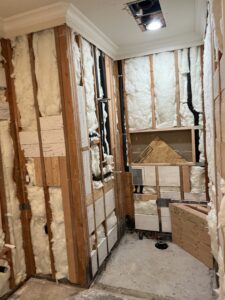
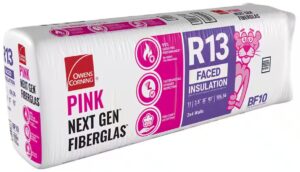 Also known as glass wool or glass fiber, fiberglass provides excellent insulating properties and is not conducive to mold, mildew, and rot. It is economical, safe, and easy to fit around plumbing, electrical, and HVAC components. It’s ideal for moisture control on walls and provides excellent temperature and noise control.
Because it’s made from glass, it’s non-combustible and adds a vital layer of fire safety to buildings. It’s ideal for moisture control on walls and provides excellent temperature and noise control. Because it’s made from glass, it’s non-combustible and adds a vital layer of fire safety to buildings.
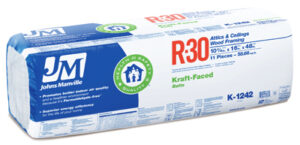 Fiberglass is versatile, making it ideal when remodeling. It comes in batts, rolls, or loose-fill; faced and unfaced. It’s also available in every R-Value for residential homes. Most fiberglass insulation contains recycled content, making it a more eco-friendly option. When combined with other air sealing measures, it helps block dust, allergens, and pollutants from entering the home.
Fiberglass will lose some of its R-Value over time.
Wool
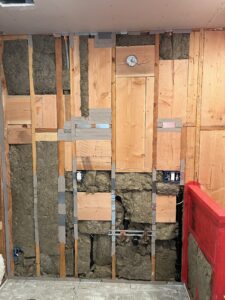
Commonly referred to as mineral wool insulation and Rockwool. Wool Insulation delivers outstanding performance in thermal control and fire resistance. Like fiberglass, it is not conducive to mold, mildew, and rot. It is safe to use and available in most R-values 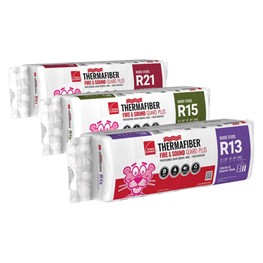 for residential homes. Wool is vermin-resistant due to its being an inorganic material.
Wool is naturally antimicrobial and non-combustible. Unlike fiberglass, wool has a much higher melting point, and as such it is often considered a more fire-resistant material. It does not easily fit around plumbing, electrical, and HVAC components.
Wool provides a higher R-value than fiberglass because the material is denser. The same 3-1/2” of wool insulation gives an R-Value of 15 vs. 13 for fiberglass. Wool will not lose its R-Value over time as it will not break down. It does not come faced. Therefore, it cannot be used in applications where a faced product is required. Because of its weight, it may not be suitable in certain applications.
In terms of sound control, mineral wool has marginally better sound control properties; however, the difference in acoustic performance is so minimal that humans would not be able to distinguish the difference between the two materials in a wall cavity.
Wool is more than double the cost per square foot compared to fiberglass.
Foam Board
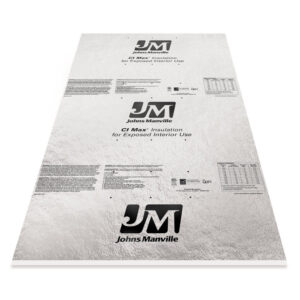
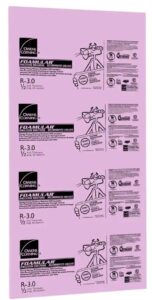 Rigid foam board is primarily used for high-performance building insulation in walls, roofs, floors, and foundations and slabs due to its excellent R-value and moisture resistance. Foam board is primarily used in underground, concrete block, Insulated Concrete Block (ICF), and pour-in-place concrete applications.
Foam board is the preferred product when bathroom and other walls are below grade. This is a common feature in communities with homes built against hillsides, such as Laguna Beach. Although it is less common in Orange County, this is typically the best product for covering interior basement walls.
Rigid foam board is available in three different applications. These are:
- EPS (Expanded Polystyrene): Versatile, good value, used widely for general insulation.
- XPS (Extruded Polystyrene): Denser, often pink/blue, great for below-grade and walls.
- Polyiso (Polyisocyanurate): Highest R-value per inch, often foil-faced for reflective properties.
The material composition and thickness of foam board determine its R-Value. For example, to achieve an R-13 value from EPS, you’ll need 3-inches of foam board. However, Polyiso only requires 2-inches of foam board.
Foam board is not cheap. For the best foam board, the cost can be more than three times that of fiberglass insulation and double the cost of wool insulation.
Always Hire a Reliable and Dependable Contractor to Remodel your Bathroom
 Always work with a trustworthy contractor like DAD’s Construction. We are experts in bathroom remodeling. We manage projects in an efficient manner. DAD’s Construction will do everything to minimize the possibility of change orders. Our team will make sure we have all the necessary information to prepare a proposal that meets your requirements. Rest assured that we will provide you with a detailed, by line-item contract. We will make sure that the contents of this agreement are properly and clearly communicated to you. If you have questions or need updates regarding your project, we will always answer your inquiries.
How Can I Receive More Information on Remodeling my Bathroom?
If you would like more information on enjoying the best bathroom, kitchen, and interior remodeling experience in Orange County, call Dan at (949) 380-0177 or at dan@dadsconstruction.com for a free consultation. DAD’s serves all of South Orange County California. This includes Lake Forest, Mission Viejo, Rancho Mission Viejo, Foothill Ranch, Portola Hills, Ladera Ranch, Irvine, San Clemente, Dana Point, San Juan Capistrano, Rancho Santa Margarita, Coto de Caza, Dove Canyon, Laguna Niguel, Laguna Hills, Laguna Beach, Newport Beach, Orange, and Aliso Viejo.